Light sensitivity causes: when the screen is the problem
The light sensitivity causes that show up at a screen are usually ordinary — a dry tear film, tired focusing muscles, or a panel much brighter than the room. Migraine is the other common one. Light sensitivity with eye pain, redness, or new blurred vision is different: get it seen today.
What photophobia actually is
Photophobia is a symptom, not a diagnosis, and not a fear of light: light most people tolerate causes you discomfort. Two pathways feed it — the trigeminal nerve, which carries pain from the eye's surface, and melanopsin-containing retinal cells that respond to light independently of sight — so photophobia causes range from a rough corneal patch to something happening in the brain. What travels alongside it tells you which end you're on.
The ordinary light sensitivity causes behind screen discomfort
A dry, unstable tear film
The tear film is the eye's first optical surface; when it breaks up between blinks, light scatters instead of focusing cleanly, and the irritated corneal nerves feed the same trigeminal pathway that drives photophobia. Screens make this worse — blink rate drops and blinks turn incomplete during demanding work, often by roughly half, though the figure varies by task. How far blink rate falls at a screen has the numbers.
A screen much brighter than the room
Your pupil sizes itself to the overall light in your field of view, not the screen alone. In a dark room the pupil opens wide, then a bright panel pushes a concentrated load through that aperture — same brightness, different experience at noon than at 11pm. Squinting at screen glare in the dark is a mechanical response to that mismatch, not weak eyes.
Focusing effort and an uncorrected prescription
Hours of near work hold focusing and convergence in one position. Uncorrected astigmatism or low farsightedness adds constant correction effort on top, and narrowing the lids sharpens a blurred image — most of why people squint. This reads as ache and fatigue more than true light pain, though the two overlap and often arrive together.
Migraine
Sensitivity to light sits in the formal diagnostic criteria for migraine, alongside nausea and sound sensitivity, and many people with migraine feel it between attacks too. If light bothers you most on days a headache is building, the screen is an amplifier, not the source — the link between eye strain and headache runs both ways.
Matching screen brightness to the room, in numbers
One test does most of the work: under the room's normal light, a white document on screen should look like a sheet of printer paper held beside it. If the paper looks gray, the screen is too bright.
The numbers behind the test:
- Office lighting guidance: roughly 500 lux for reading and writing, 300 lux for lighter work — most home desks at night sit well below that.
- Laptops and monitors typically top out near 250–400 cd/m²; a properly lit room needs closer to 100–150 cd/m² — usually 30–50% on a brightness slider.
- Ergonomic guidance keeps the luminance ratio between screen and the surface right behind it near 3:1, and within about 10:1 across your wider field of view.
- A dark room deletes the bottom of that ratio — the screen becomes the only light source in view, so a lamp behind the display fixes it better than dimming the screen further.
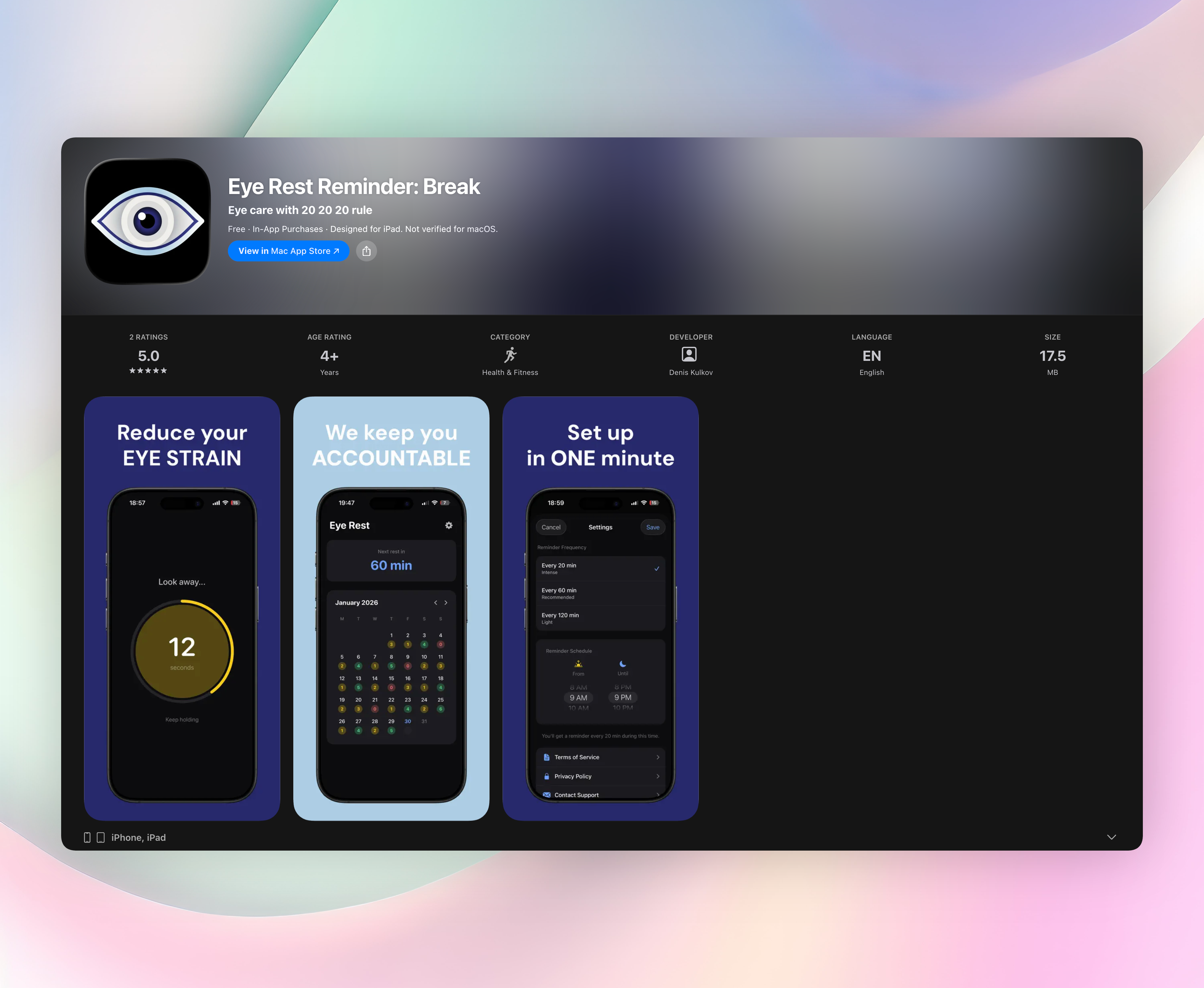
Brightness matching handles the steady load; the other half is not staring at one bright target for hours. A periodic look at something across the room lets focusing and blinking reset. Eye Rest Reminder, an eye-break reminder app for iPhone and Apple Watch, schedules those distance breaks between screen stretches so you aren't tracking them yourself.
When light sensitivity needs same-day care
| Ordinary screen-related | See someone today | |
|---|---|---|
| Which eyes | Both, about equally | One eye, or clearly worse in one |
| Pain | Ache, grit, heaviness | Deep or throbbing pain inside the eye |
| Vision | Briefly blurry, clears on a blink | New or persistent blur, halos around lights |
| Appearance | Normal or slightly bloodshot | Red ring around the iris, or a hard red eye |
| Onset | Builds over hours at a screen | Arrived with no screen trigger |
| What comes with it | Neck and shoulder tension | Nausea, vomiting, fever, stiff neck, recent injury |
Persistent one-sided photophobia is not a screen-hygiene problem, nor is light sensitivity after an eye injury, during contact lens wear with pain or discharge, or after eye surgery. One useful sign: light shone into your unaffected eye hurting the other one points to inflammation inside the eye and needs prompt assessment — a sudden hard, red, painful eye with halos and nausea is an emergency.
None of that makes every bout of light sensitivity serious — it just needs a symmetric, pain-free, screen-hours pattern to hold.
Where the evidence is genuinely mixed
Blue-light filtering lenses are the clearest case: review of the randomized trials found no reliable benefit for screen-related visual fatigue, even though many wearers feel better. They're harmless if you like them, but not a fix for light sensitivity.
Dark mode is unsettled differently: it cuts total light output, which helps in a dim room, but dark text on a light background tends to read slightly better in bright conditions — the brighter field constricts the pupil and deepens focus. The dark mode question mostly comes down to your ambient light.
Flicker has the thinnest evidence: some people report discomfort on displays that dim by pulsing at low brightness — worth taking seriously, but controlled studies are sparse.
FAQ
Why are my eyes sensitive to light all of a sudden?
Sudden light sensitivity with no pain, redness, or vision change is usually dry eye, a migraine starting, or an environmental change — new monitor, brighter room, new medication. Some medications list it as a side effect, so flag it to your prescriber. Sensitivity in one eye, or with pain, needs same-day care.
Why do my eyes hurt when looking at screen light but not daylight?
Daylight is diffuse and fills your whole field of view, so the pupil adjusts once and settles. A screen is a small bright rectangle in a darker field, and near work adds sustained focusing effort on top. If daylight bothers you equally, the screen probably isn't the main driver.
Does squinting at a screen mean I need glasses?
It can. Uncorrected astigmatism and low farsightedness both make people squint, since narrowing the lids sharpens a blurred image — though it's also just what people do when a screen outshines the room. An eye exam answers it faster than experimenting with settings.
Is screen-related light sensitivity permanent?
There's no good evidence that ordinary screen use causes lasting damage or lasting photophobia. Sensitivity driven by dry eye and brightness mismatch generally settles once those change. Light sensitivity that persists for weeks without an obvious trigger deserves a proper workup, not more screen tweaks.
Free Eye Rest Reminder tools
- 20 Minute TimerUse this 20 minute timer to mark the interval between eye breaks. Start a countdown, pause it when needed and reset it for the next interval.
- 20 Second TimerA 20 second timer for the 20-20-20 rule — every 20 minutes, look at something about 20 feet away for 20 seconds. Press start, or hit the space bar. One-tap 20, 30 and 60 second presets, a custom duration, an optional chime and a breathing circle to rest your eyes on.
- Break Interval TimerSet timer for 20 minutes, add a short break, and repeat the cycle for focused screen time. Every interval and cycle count is editable.
- Screen Break PlannerPlan screen breaks around your workday, lunch and meetings. Get a printable schedule with break times, break count, total break minutes and screen time after breaks.