
Can dry eyes cause blurry vision after screen work?
Yes. Dry eyes blur vision by roughening the tear film your eye focuses through, and that blur fluctuates — it smears, clears for a second when you blink hard, then smears again. Blur that stays constant no matter how you blink is a different problem.
Can dry eyes cause blurry vision on their own?
They can, before anything inside the eye is involved. Light entering your eye bends first at the boundary between air and the tear film. That surface, with the cornea underneath it, supplies roughly two-thirds of the eye's focusing power — more than the lens inside does.
A healthy tear film stays smooth between blinks. When the oily outer layer thins or the watery layer evaporates too fast, the surface breaks into dry patches, light scatters there instead of forming a clean image, and vision goes soft — a smear, or a faint halo around white text.
Clinicians measure this as tear break-up time: how long a stained tear film stays intact after a blink. Under ten seconds is generally treated as unstable, under five as clearly abnormal. When break-up is shorter than the gap between your blinks, the surface is dry for part of every cycle. That's when letters go soft.
The two-blink test: does the blur clear when you blink hard?
Wait until the blur shows up, usually an hour or two into concentrated work. Close both eyes firmly for a full second, open them, and immediately read a line of small text at the distance that went blurry. Do it once at the screen, once across the room.
Tear-film blur clears, briefly. A hard, complete blink resurfaces the eye and text sharpens for a few seconds before softening again. Focusing and prescription blur don't behave that way: the text looks identical after the blink, and squinting helps more than blinking does.
| What you notice | Tear-film (dry eye) blur | Focusing or prescription blur |
|---|---|---|
| After a hard blink | Sharpens a few seconds, then returns | No change |
| Across the workday | Worse late afternoon and evening | Steady, or worse with fatigue |
| Which distance | Whatever you look at, near or far | Usually one distance is worse |
| Squinting | Little help | Often sharpens noticeably |
| Traveling with it | Grittiness, burning, watering, light sensitivity | Aching brow, headache, slow focus shifts |
| Between the two eyes | Often unequal, shifts sides | A stable difference |
Why your blink rate collapses in front of a screen
Blinking is mostly automatic, and concentration suppresses it. Relaxed rates are commonly quoted around 15 to 20 a minute; during focused screen work, reported rates fall to a fraction of that, often roughly a third. Figures vary widely between studies and between people, but the direction is consistent — and the same suppression appears during demanding reading on paper. Sustained visual attention is the culprit, not the display.
Rate isn't the whole story. Incomplete blinks, where the lids don't fully meet, leave part of the lower cornea unresurfaced — one reason the smear often sits low in your field. A monitor above eye level makes you look up, opening the lids wider and exposing more surface. Forced-air heat, air conditioning, ceiling fans, and a vent aimed at your face all speed up evaporation.
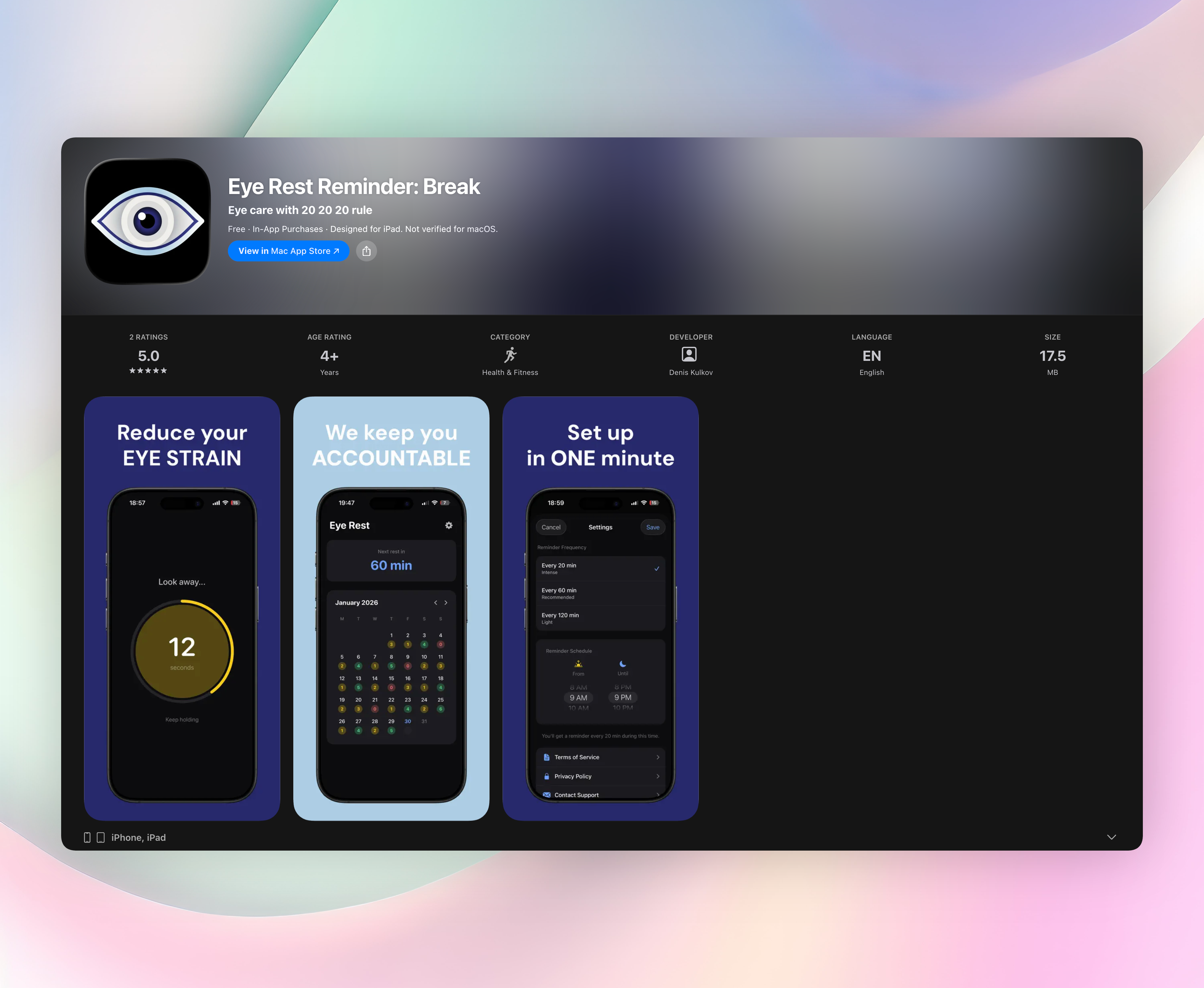
The workable fix isn't blinking on command — nobody sustains that for eight hours — but interrupting the long unblinking stretches. Anything that pulls your eyes off the screen restarts the cycle: a look out the window, a phone call, someone walking in. When those don't happen on their own, a timed prompt does the same job. Eye Rest Reminder is an eye-break reminder app for iPhone and Apple Watch; a look-away prompt earns its place by landing mid-stretch, in the hour you'd otherwise stare straight through.
How blink rate shifts at a screen is worth understanding before spending money on anything, and the 20-20-20 rule is the usual starting cadence.
Can eye strain cause blurry vision too?
It can, through a different mechanism. Holding focus at one near distance for hours keeps the ciliary muscle contracted, and it can be slow to release when you look up — distant objects stay soft for anything from a few seconds to an hour. Optometrists call the stubborn version accommodative spasm, or pseudomyopia, and it shows up more in people under about 40, whose focusing range is still wide enough to lock up.
Strain blur has its own signature: it appears when you change distance rather than between blinks, it travels with a dull ache behind or above the eyes, and a hard blink does nothing for it. Both often run at once, since the stretch that dries your tear film also holds your focus fixed. If the blur arrives with other eye-strain symptoms, assume you have both.
Why the blur is worst late in the afternoon
Several things stack up. Tear production falls with fatigue and later hours. Hours of reduced blinking leave the oily layer thin and unevenly spread. Indoor air pulls moisture off the surface the whole time, and the focusing muscle has been loaded since morning. Contact lenses compound each step, since the lens sits in the tear film and thins the layer above it.
Medication matters too. Antihistamines, some antidepressants, diuretics, hormonal contraceptives, and isotretinoin are all known to reduce tear production. If your temporary blurry vision started within weeks of a new prescription, mention it to whoever wrote it.
Red flags that mean stop and get seen today
None of this applies to blur that arrives suddenly, sits in one eye, or comes with pain. Get examined the same day for:
- Sudden blur or vision loss in one eye, with or without pain
- Blur with eye pain, a red eye, halos around lights, nausea or vomiting — possible acute angle-closure glaucoma
- A shower of new floaters, flashes of light, or a curtain across part of your field — possible retinal detachment
- Blur with double vision, a drooping lid, weakness, slurred speech, or a severe unfamiliar headache — treat as a stroke-level emergency
- Blur that never fluctuates and has worsened steadily over days or weeks
One more pattern: blur that shifts over days rather than seconds, especially with unusual thirst or urination, can reflect blood sugar swings changing the lens. That's a physician's question, not a screen-habit one.
Where the evidence is solid, and where it isn't
The mechanism is well established: blinking resurfaces the tear film, blink rate falls during sustained visual tasks, and an unstable tear film measurably degrades optical quality. Several popular remedies rest on thinner ground.
- The 20-20-20 rule is cheap and sensible, but the trial evidence behind that specific interval is limited. It's a memorable convention, not a measured optimum.
- Blue-light-filtering lenses: the better systematic reviews have not found a clear benefit for eye-strain symptoms, and they aren't aimed at tear-film blur.
- Humidifiers, omega-3 supplements, and screen filters have plausible mechanisms and mixed or inconclusive trial results.
- Lubricating drops are what clinicians usually reach for first, though formulations differ and comparisons between them are weak — a question for an optometrist.
Symptoms lasting more than a couple of weeks belong with someone who can look at your tear film and measure your refraction.
FAQ
Do dry eyes cause blurry vision in both eyes at once?
Usually both, rarely to the same degree. One eye often has a faster break-up time or a leakier lid seal, so the blur wanders side to side across the day. Blur locked into one eye and unchanged by blinking is a different situation and needs an exam.
How long does temporary blurry vision from screen work last?
Tear-film blur clears in seconds with a complete blink and settles within a few minutes away from the screen. Focusing blur after a long near stretch can take several minutes to an hour to release. Blur present all day, every day, isn't a screen-habit story.
Can eye strain cause blurry vision that's still there the next morning?
Not typically — accommodative blur resolves with sleep. Blur present on waking and steady all day points elsewhere: a refractive change, the corneal surface, or something systemic. A separate pattern, where blur on waking clears within an hour, can relate to how the lids sit overnight and is worth describing to an optometrist.
Will new glasses fix blur that comes and goes?
No. A prescription corrects a fixed focusing error and can't stabilize a tear film. A refraction measured on a dry surface can even come out slightly off, which is one reason to have the tear film assessed before committing to new lenses — especially if your numbers moved more than expected.
Free Eye Rest Reminder tools
- 20 Minute TimerUse this 20 minute timer to mark the interval between eye breaks. Start a countdown, pause it when needed and reset it for the next interval.
- 20 Second TimerA 20 second timer for the 20-20-20 rule — every 20 minutes, look at something about 20 feet away for 20 seconds. Press start, or hit the space bar. One-tap 20, 30 and 60 second presets, a custom duration, an optional chime and a breathing circle to rest your eyes on.
- Break Interval TimerSet timer for 20 minutes, add a short break, and repeat the cycle for focused screen time. Every interval and cycle count is editable.
- Screen Break PlannerPlan screen breaks around your workday, lunch and meetings. Get a printable schedule with break times, break count, total break minutes and screen time after breaks.