Eyelid twitching causes, and how to find yours
An eyelid twitch is almost always benign eyelid myokymia — a fine, involuntary ripple in the muscle that rings your eye. The eyelid twitching causes worth investigating are fatigue, caffeine, stress, and eye strain. It's a nerve-and-muscle event, not an eye problem.
What's actually twitching
The muscle is the orbicularis oculi, a flat sheet of fibers that circles the socket and squeezes the lids shut. Myokymia is a small subset of those fibers firing on their own — closer to the flicker you get in a tired calf than to anything your eye is doing.
The signal arrives on the facial nerve, cranial nerve VII, whose motor branch controls the muscles of facial expression, including this one. The optic nerve, retina, and cornea aren't involved, which is why sight stays normal during an episode. The eyeball is fine. The lid is buzzing.
Scale explains the strangest part of it. People ask why does my eye twitch this violently when nobody else can see it, and the answer is that the movement is a millimeter or two, under the thinnest skin on the body, pressed against the globe. You feel it as pressure. Look in a mirror mid-episode and there's often nothing to see.
The four reliable eyelid twitching causes
The clinical list is short because it's the list that reproduces. Remove the trigger and the twitch fades; put it back and it returns.
Sleep debt. The most consistent of the four. A run of five-hour nights can produce a lid twitch even in people with no other risk factor, and catching up tends to end it without anything else changing.
Caffeine. Dose-dependent and highly individual — some people twitch at three cups, others never do. Caffeine's half-life in healthy adults is usually given as around five hours, so a 4 p.m. cup still has meaningful blood levels at bedtime, which folds it back into the sleep trigger.
Stress. Sustained sympathetic arousal is the mechanism people point to, and it's the hardest of the four to isolate, because stressful weeks are also short-sleep, high-caffeine weeks.
Eye strain. Hours of held near-focus: accommodation and convergence locked at one distance, plus a blink rate that drops well below its resting level when you're concentrating. Tired eyes and a twitching lid tend to show up in the same week, which isn't a coincidence — one long session produces both, along with the wider cluster of eye strain symptoms.
Alcohol, nicotine, dry eye, and uncorrected refractive error belong on the list too — an out-of-date prescription makes the focusing system work harder for the same result.
Why eye twitching from screens is so common
A long screen session doesn't add a fifth cause. It stacks three of the four you already have.
Concentrate on a display and spontaneous blinking slows sharply from its resting rate, so the tear film thins and the surface gets irritated. Accommodation stays fixed at a monitor's working distance — commonly 50 to 70 cm — for hours, with no far-focus interruptions. And the work holding you at the screen is usually the work you're stressed about, often the reason you slept badly. Eye strain from phone use compresses it further: a phone sits nearer 30 cm, with smaller type, which raises accommodative demand rather than lowering it.
Breaking up sustained near work is the standard countermeasure, usually packaged as the 20-20-20 rule for eye strain — every 20 minutes, look at something about 20 feet away for 20 seconds. Worth stating honestly: those numbers are a memorable heuristic, not a validated dose. Interrupting continuous near focus has better support than the specific interval does.
How long an eyelid twitch lasts
Individual episodes run from a few seconds to a couple of minutes. The underlying state is intermittent — it fires several times a day for a few days, goes quiet, comes back. Most cases settle within a couple of weeks as the trigger stack lightens, though some run on and off longer, tracking a long stressful stretch.
Two features stay reassuring throughout. It remains in one eyelid, most often the lower lid on one side, and it stops while you sleep.
When eyelid twitching isn't myokymia
Two other conditions get confused with a simple lid twitch, and both look different once you know the tells.
| Feature | Eyelid myokymia | Benign essential blepharospasm | Hemifacial spasm |
|---|---|---|---|
| Appearance | Fine ripple, often invisible to others | Forceful, sustained closure of the lids | Contraction across one side of the face |
| Spread | Stays in one eyelid | Both eyes, may involve the brow | Eye first, then cheek and mouth over months |
| Sides affected | One | Usually both | Strictly one |
| Effect on sight | None | Can hold the eyes shut | Eye can be pulled closed |
| During sleep | Stops | Stops | Often continues |
| Typical course | Days to a few weeks | Chronic, progressive | Chronic, progressive |
Worth getting looked at: twitching that spreads beyond the eyelid into the cheek or mouth, forceful closure of both eyes, movement that persists in sleep, a twitch running many weeks without let-up, or one arriving alongside a drooping lid, facial weakness, double vision, discharge, or twitching in other muscle groups.
Finding your own trigger, in order
Change one variable at a time, about a week each. Changing all four at once tells you nothing about which mattered.
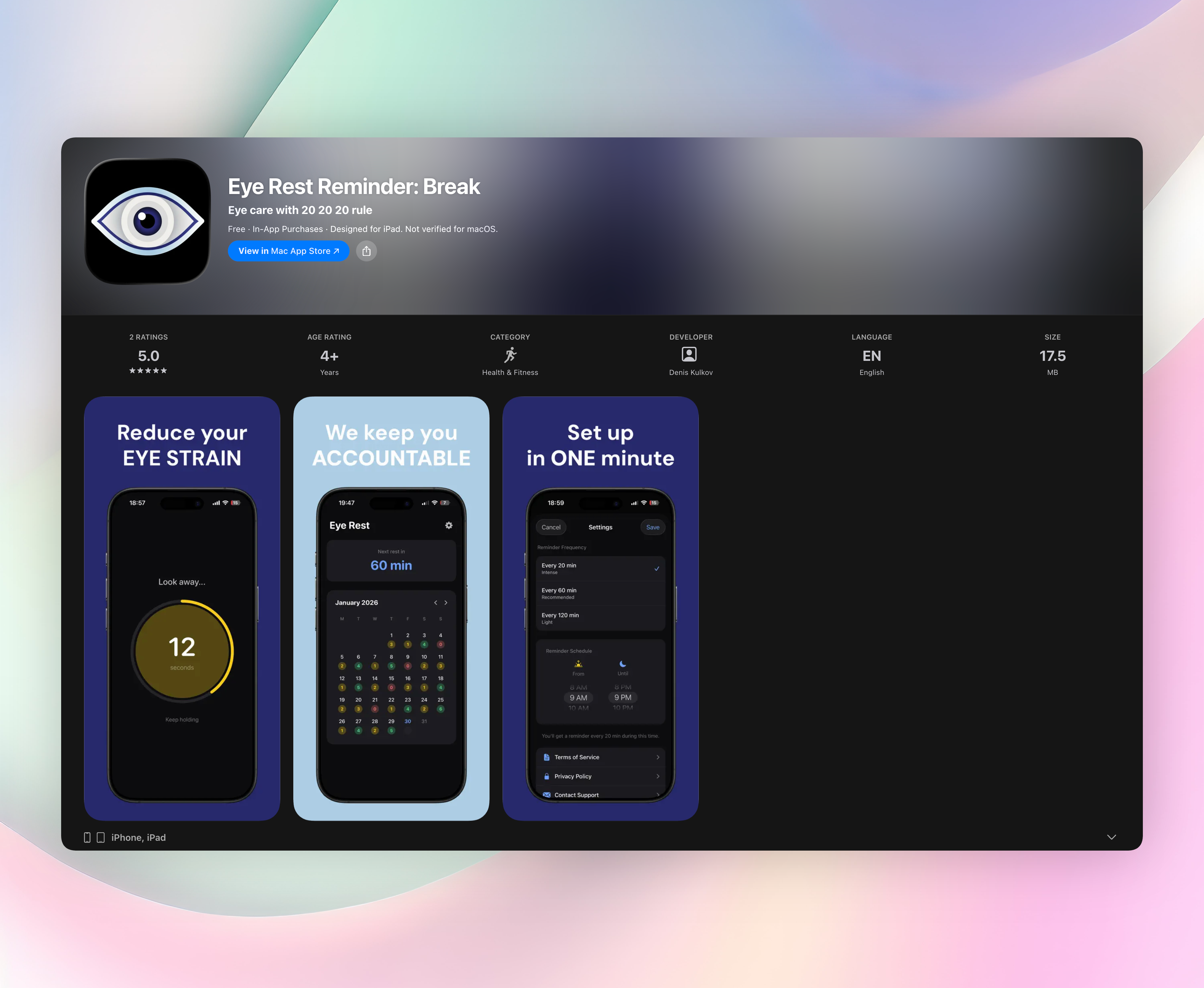
- Uninterrupted screen blocks. Start here — it's the one variable most people can move without giving up coffee or sleep. Cap continuous near work at 20 to 30 minutes and take a real far-focus break, not a glance at your phone. The failure mode is forgetting, not disagreeing, which is where a nudge helps: Eye Rest Reminder is an eye-break reminder app for iPhone and Apple Watch.
- Caffeine. Halve it rather than quitting outright, since withdrawal headaches muddy the reading, and move the last dose before noon so it stops contaminating your sleep.
- Sleep. Hardest to shift, largest single effect. Two weeks of consistent hours is a fair test.
- The surface and the prescription. Dry eye and an out-of-date correction both raise visual fatigue, and an eye exam settles both faster than guesswork.
- Stress. Last, because you can't blind yourself to it and it moves on its own timeline.
Things that get recommended but don't hold up well
Magnesium and potassium supplements dominate the search results here, but a genuine deficiency is uncommon in people eating normally, and the link to myokymia is largely assumed rather than demonstrated.
Blue-light filtering lenses are the other one. Reviews of the trials haven't found a reliable effect on eye strain symptoms, so the picture on blue light glasses is better described as unconvincing than settled. How long you stare without a break appears to matter more than which wavelengths reach your retina.
FAQ
Why does my eye twitch when I'm tired?
Sleep deprivation makes motor nerves more excitable, and the small motor units feeding the orbicularis oculi are a common place it shows up. It's the most reproducible of the triggers — plenty of people can predict a twitch from their last few nights of sleep.
Can eye twitching from screens damage my eyes?
There's no evidence that benign eyelid myokymia harms the eye or lid. It's a temporary misfire in a motor nerve, not tissue damage, and it leaves nothing behind when it stops.
How do I stop an eyelid twitch right now?
Nothing reliably aborts an episode once it's started, and any claim otherwise is overselling. The realistic move is removing the trigger — sleep, caffeine, break frequency — and letting it fade over the following days.
Should I see a doctor if my eye has been twitching for two weeks?
Two weeks of intermittent lower-lid flutter is within the normal range for myokymia. It's worth raising if the twitching spreads past the eyelid, involves both eyes forcefully, continues while you're asleep, or comes with any other neurological change.
Does caffeine actually cause eyelid twitching?
It's one of the four standard triggers, though the threshold varies a lot between people. The cleanest test is halving your intake for a week while holding sleep and screen habits steady.
Free Eye Rest Reminder tools
- 20 Minute TimerUse this 20 minute timer to mark the interval between eye breaks. Start a countdown, pause it when needed and reset it for the next interval.
- 20 Second TimerA 20 second timer for the 20-20-20 rule — every 20 minutes, look at something about 20 feet away for 20 seconds. Press start, or hit the space bar. One-tap 20, 30 and 60 second presets, a custom duration, an optional chime and a breathing circle to rest your eyes on.
- Break Interval TimerSet timer for 20 minutes, add a short break, and repeat the cycle for focused screen time. Every interval and cycle count is editable.
- Screen Break PlannerPlan screen breaks around your workday, lunch and meetings. Get a printable schedule with break times, break count, total break minutes and screen time after breaks.