Is dark mode better for your eyes, or is it just brightness?
Dark mode isn't automatically easier on your eyes. In a lit room, most sighted readers do better with dark text on a light background; in a dim room, dark mode is more comfortable. Brightness matched to the room matters more than which mode you pick.
Is dark mode better for your eyes? The research is split
Vision researchers call this contrast polarity. Positive polarity is dark text on a light background — the printed-page arrangement. Negative polarity is light text on dark. Human-factors work on displays has generally found a positive-polarity advantage under normal room lighting: slightly faster reading, fewer proofreading errors, better resolution of small text.
The likely mechanism is pupil size. A bright background constricts the pupil, which increases depth of field and sharpens the retinal image the way stopping down a camera lens does. A mostly-dark screen lets the pupil open, and a wide pupil is less forgiving of blur and of your own optical aberrations.
The effect is real but modest, and it's measured on sustained reading in lit rooms. It doesn't mean dark mode harms anything, and it doesn't generalize to every eye. Much of what gets called dark mode eye strain is a brightness mismatch wearing a theme.
Where dark mode wins
Dim and dark rooms. A full-white page in an unlit room is a small lamp aimed at your face. Dark mode cuts emitted light sharply — on an OLED panel, black pixels are simply off — and shrinks the gap between the screen and its surroundings.
Light sensitivity. People dealing with photophobia from migraine, dry eye, or concussion recovery often say dark mode is the only way they can stay on a screen. Some low-vision users prefer it too.
Glanceable interfaces. Dashboards, editors, maps at night. Anything you scan instead of read loses little to negative polarity.
Halation: why some people can't read white on black
If white text on black looks like it's glowing or smearing into the background, that's halation. It shows up most with uncorrected astigmatism, and it explains why a subset of readers find dark mode harder even in a dark room. Dry eye produces a similar blur.
If light text bleeds and dark text doesn't, that's information about your optics rather than about the interface — worth raising at your next eye exam.
Brightness beats mode: the best screen brightness for eyes
This does more than any theme switch. Your screen should look about as bright as a sheet of white paper lying on the desk beside it. Open a blank white document, hold a piece of paper up next to the display, and adjust until the two look like the same material. Screen glowing next to the paper? Too bright. Paper looks white while the screen looks gray? Too dim.
Redo it whenever the light changes; auto-brightness gets close but tends to run hot in dark rooms. Ambient light counts as much as the panel: no bare overhead glare, no bright window directly behind or facing the screen, and a soft lamp behind the monitor so the surround isn't pitch black.
| Situation | Better choice | Why |
|---|---|---|
| Long reading, lit room | Light mode | Positive-polarity advantage; smaller pupil, sharper text |
| Dim room, evening | Dark mode | Less light emitted, smaller screen-to-room mismatch |
| Astigmatism, visible halation | Light mode | Light-on-dark text smears |
| Photophobia or migraine | Dark mode | Less total light reaching the eye |
| Code, dashboards, glanceable UI | Either | Scanning shows little polarity effect |
| Screen brighter than the room | Fix brightness first | The mismatch outweighs the mode |
Night Shift, blue light, and screen time eye damage
Two separate claims get tangled together. The first is that screens deliver enough blue light to hurt the retina. There's no solid evidence for that — a display emits far less blue light than ordinary daylight, and the screen time eye damage framing runs ahead of the research. Digital eye strain is real, but it tracks reduced blinking, sustained near focus, glare, and posture. That's also why trials of blue light glasses have been unimpressive for strain symptoms.
The second claim is about sleep. Evening light does shift circadian timing, and warm display modes get marketed as a night shift eye strain fix. Their real target is sleep, not comfort, and even there the results are mixed. Warming the display after dark costs nothing; expecting it to fix strain is a stretch.
Monitor settings for eye strain, in order of payoff
- Brightness matched to the room. The paper test above. Everything below it is smaller.
- Bigger text. Most people run type a size or two below what they'd pick if nobody was watching. Larger text cuts focusing effort more reliably than any color setting.
- Glare control. A repositioned lamp or a matte finish beats every software tweak for reflections.
- Monitor position. Roughly arm's length away, top of the screen at or just below eye level, so your lids cover more of the eye surface.
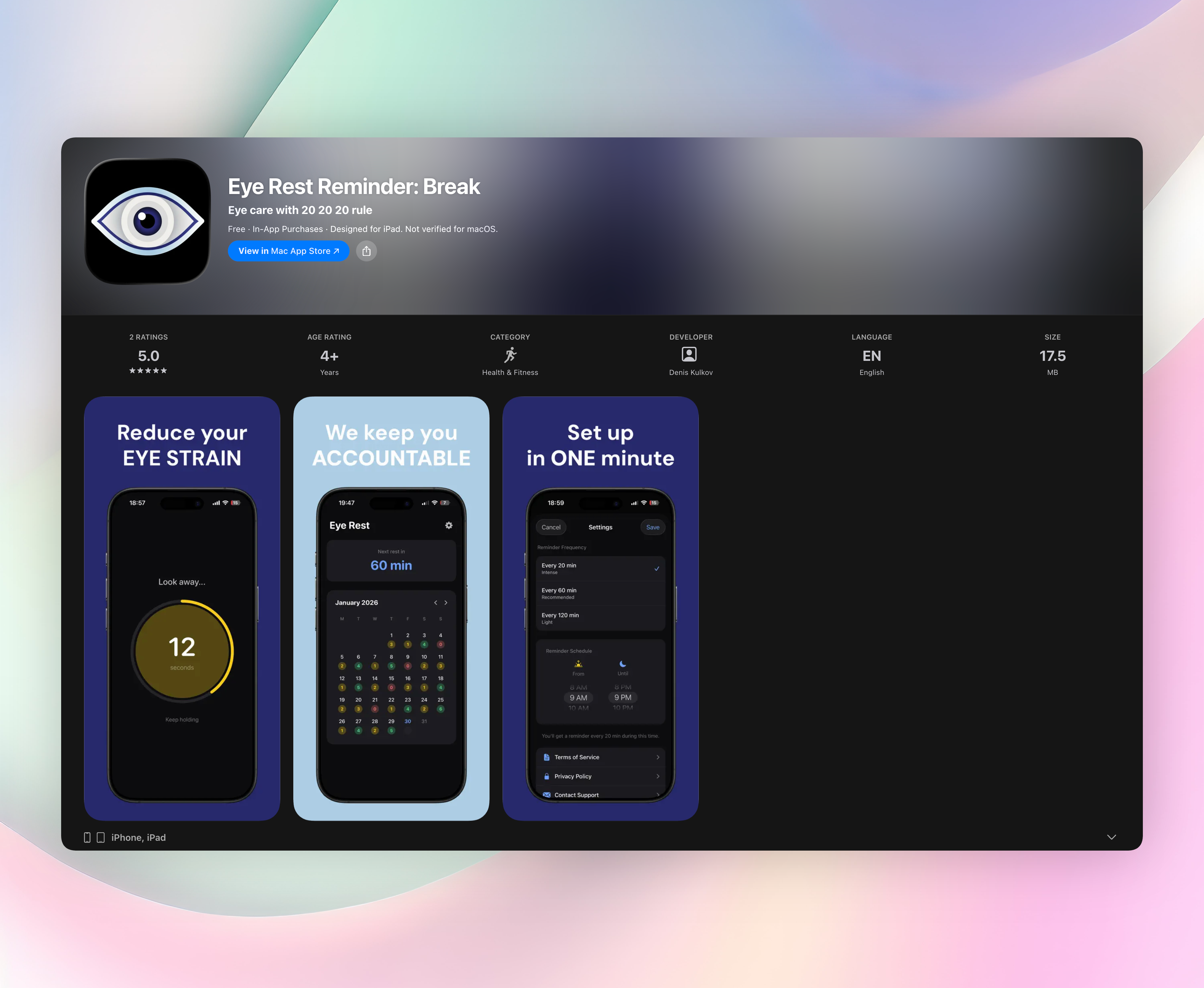
- Breaks. Display tuning lowers strain per minute; breaks limit the minutes, and neither substitutes for the other. The 20-20-20 rule is the usual starting point, and if you lose track of time, Eye Rest Reminder — an eye-break reminder app for iPhone and Apple Watch — covers that half.
Switch by time of day, not by identity
The practical setup for most people isn't one mode at all. Light mode for reading-heavy work in daylight, dark mode once the room lights come down, brightness re-checked at each switch. iOS, macOS, and Android can schedule the change around sunset automatically; Windows still means switching by hand or with a scheduling utility. Let the room decide instead of picking a side.
FAQ
Does dark mode reduce eye strain?
Sometimes. In a dim room it cuts the light reaching your eyes, which usually feels better. In a well-lit room, controlled reading studies tend to favor light mode. Match brightness to the room before comparing the two, or you're testing brightness rather than mode.
Is dark mode bad for your eyes?
No. Neither polarity has been shown to cause damage. Light-on-dark text is measurably slower to read for most sighted people in daylight conditions, and it can look blurry if you have astigmatism, but slower reading isn't injury.
What's the best screen brightness for eyes at night?
Low enough that the screen doesn't stand out from the room, but not so low you squint. Turn on a small lamp rather than dropping the display to its minimum in the dark — a dim screen in a dark room still leaves the pupil wide and the focusing effort high.
Should I use dark mode if I have astigmatism?
Try light mode first. Halation from light-on-dark text is a common complaint with uncorrected astigmatism. If white text on black looks like it's glowing, that's a reason to have your prescription checked rather than to keep hunting for the right theme.
Free Eye Rest Reminder tools
- 20 Minute TimerUse this 20 minute timer to mark the interval between eye breaks. Start a countdown, pause it when needed and reset it for the next interval.
- 20 Second TimerA 20 second timer for the 20-20-20 rule — every 20 minutes, look at something about 20 feet away for 20 seconds. Press start, or hit the space bar. One-tap 20, 30 and 60 second presets, a custom duration, an optional chime and a breathing circle to rest your eyes on.
- Break Interval TimerSet timer for 20 minutes, add a short break, and repeat the cycle for focused screen time. Every interval and cycle count is editable.
- Screen Break PlannerPlan screen breaks around your workday, lunch and meetings. Get a printable schedule with break times, break count, total break minutes and screen time after breaks.