
How to use a warm compress for dry eyes
A warm compress for dry eyes works by softening the waxy oil stuck in the glands along your lid margin. It needs sustained heat near 40°C (104°F) for 8–10 minutes, followed by a gentle lid massage. A damp washcloth cools too fast to do either.
Why heat, and not just moisture
The glands that matter sit inside the eyelids: the meibomian glands, roughly 25–40 in the upper lid and 20–30 in the lower, opening in a row behind the lash line. They secrete meibum, an oily layer that spreads across the tear surface with each blink and slows evaporation. When it thins or gets patchy, the tear film's watery part disappears faster than it should — the eye feels dry even while it's making plenty of tears.
Meibum is a wax, not a liquid: in a healthy gland it stays fluid at body temperature. Once a gland is inflamed or stagnant, the meibum thickens and its melting point climbs, so at normal lid temperature it sits in the duct like cold butter — heat is the only tool you have at home that changes that.
That also explains why drops and compresses aren't competing: drops top up the water layer, a compress targets the oil layer that stops it evaporating, and most people need both. If your vision smears between blinks rather than staying blurry, that's the tear film breaking up, not a prescription change — more in blurry vision after screen work.
The temperature and time that make a warm compress for dry eyes work
Temperature. The commonly cited target is around 40°C at the eyelid, held steady. Much below that and thickened meibum won't reliably soften; much above 45°C and you risk a burn, since eyelid skin is the thinnest on the body. Warm and comfortable — never sharp or stinging.
Time. Eight to ten minutes of actual heat, not eight to ten minutes of ritual. Outer lid skin warms quickly, but the glands sit deeper and the inner lid lags behind, so a short application warms the skin and leaves the wax untouched.
Choosing a heat source
A wet flannel is the least reliable option — it cools too fast unless you keep re-wetting it. Everything else compared:
| Heat source | Realistic time near 40°C | Worth knowing |
|---|---|---|
| Washcloth, applied once | About 2 minutes | Cools fast as water evaporates |
| Washcloth, re-wet every 2 min | 8–10 minutes, in theory | Only if you actually do it |
| Microwaved bead mask | Roughly 8–12 minutes | Usual answer; even heat both lids |
| DIY rice or flaxseed sock | Roughly 8–10 minutes | Same physics, free; shake out hot spots |
| Electric heated eye mask | As long as it's on | Steady heat is the real benefit — get a thermostat model |
| Hot shower steam | Not meaningful | Nowhere near the lid temperature required |
How to make a warm compress for eyes at home
A grain-filled compress takes five minutes:
- Fill a clean sock or fabric pouch two-thirds with rice, flaxseed, or dried beans — flaxseed holds heat longest.
- Tie it closed, leaving the filling loose enough to shift.
- Microwave in 20–30 second bursts, shaking between each — not one long blast that scalds the core.
- Test it on your wrist first; it should feel warm, not hot.
- Rest it over closed eyes for 8–10 minutes, reheating once partway through if it fades.
Keep the filling dry and replace the grain every couple of months — damp grain can grow mold. Bead masks do the same job with more even heat and a washable cover, so most clinics recommend one instead.
The massage after is not optional
Heat softens the wax; it doesn't clear it. As soon as the compress comes off, while lids are still warm, roll a clean fingertip along the lid — upper lid down toward the lashes, lower lid up toward the lashes. Light pressure, a few passes, about 30 seconds per lid: you're expressing a row of small tubes toward their openings, not rubbing the eyeball.
Then wipe the lid margin: draw a clean, warm cloth over a fingertip along the lash line to lift away the oil you just mobilized, so it doesn't settle back over the openings. Lid wipes and foams do the same job — the target is the margin, not the skin around it.
Skip the massage — and check with an optometrist first — if you've had recent eye surgery or a diagnosed corneal condition.
Twice daily while symptoms are active, tapering to once a day for maintenance, is usual. Progress runs in weeks, not days — a gland that's already atrophied (visible on meibography) won't be brought back by heat. Compresses are standard first-line self-care with a well-described mechanism, but trial evidence is modest: reasonable to try, not guaranteed.
Blinking exercises for dry eyes
This one costs nothing. Spontaneous blink rate is usually quoted at roughly 15–20 per minute at rest and falls during screen work — but the bigger problem is quality, not rate: a larger share go incomplete, lids never fully meeting. That doesn't sweep the margin or spread the oil, so the lower cornea dries first — exactly why blink rate dropping in front of a screen matters as much as how often you blink.
The standard drill: close gently, close gently again, then squeeze shut for two seconds. Five rounds, a few times a day, plus full blinks whenever you look away from the screen — it pairs naturally with a break cadence like the 20-20-20 rule, since looking away is when you blink properly again.
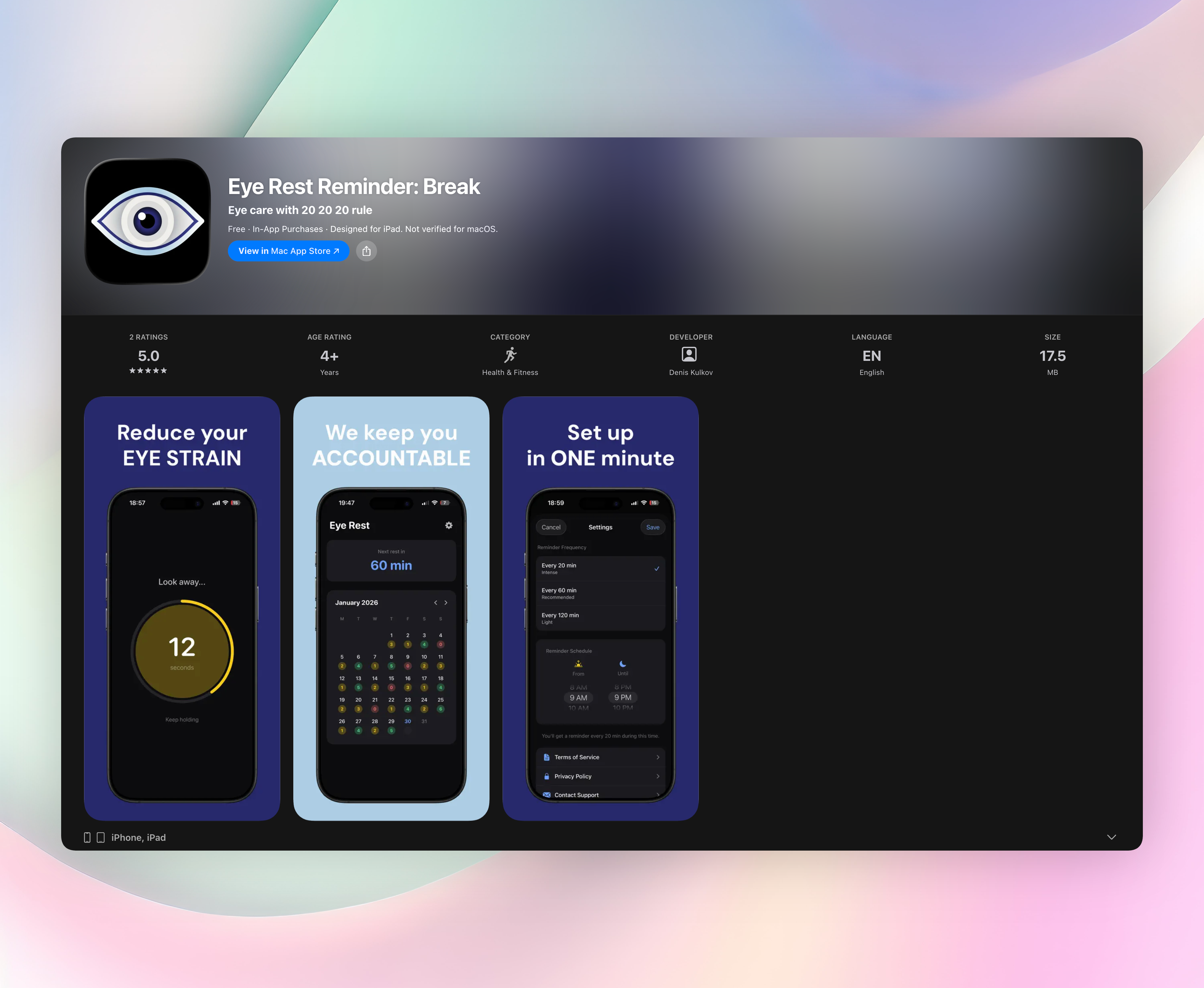
A compress deals with a tear film that has already broken down; a break reminder is aimed at not letting it get that far. Eye Rest Reminder is an eye-break reminder app for iPhone and Apple Watch, which is a practical way to keep the break-and-blink habit going when work pulls your attention in.
Humidifier for dry eyes: reasonable, within limits
Tears evaporate faster in dry air, and indoor humidity during winter heating or on a plane often sits below the 40–50% range most find comfortable. Raising it is cheap and the mechanism is sound, but proof it changes dry-eye signs — not just comfort — is thin; treat it as comfort infrastructure, not therapy. Airflow matters just as much: a vent, fan, or car vent aimed at your face will out-dry anything a humidifier adds back. Point them away, and clean the reservoir on schedule — a dirty one aerosolizes what's growing in it.
Omega-3 for dry eyes: where the evidence disagrees
This is the most oversold item in the category. The reasoning is plausible — meibum composition and surface inflammation both respond to dietary fat — and small trials have reported improvement. But the largest, most tightly controlled trial in the field found no meaningful advantage over its placebo oil, and reviews since have landed on "uncertain": it may help some people, but the effect isn't reliable and nothing happens fast. Eating oily fish is a good idea regardless — just don't let a supplement replace the heat.
FAQ
How long should I hold a warm compress on my eyes?
Eight to ten minutes of real heat, once or twice a day — shorter sessions warm the skin without reaching the glands. If it cools partway through, reheat and finish rather than stop early.
Can I just use a hot washcloth instead of a mask?
You can, but only if you re-wet it every two minutes — applied once, it drops toward skin temperature within a couple of minutes. A microwaved bead or grain mask holds usable heat for most of a session on its own.
Is it safe to use a warm compress on my eyes every day?
Daily use at a comfortable temperature is what's normally recommended. Avoid overheating — eyelid skin burns easily, so test on your wrist first — and avoid pressing hard on the eyeball during the massage. Check with an eye doctor if you've had recent eye surgery or a diagnosed corneal condition.
How soon will a warm compress help?
Some people notice their eyes feel less gritty the same evening, but changes in gland function take weeks of consistent use. If four to six weeks of daily compresses and lid wipes make no difference, that's worth an eye exam rather than escalating on your own.
Free Eye Rest Reminder tools
- 20 Minute TimerUse this 20 minute timer to mark the interval between eye breaks. Start a countdown, pause it when needed and reset it for the next interval.
- 20 Second TimerA 20 second timer for the 20-20-20 rule — every 20 minutes, look at something about 20 feet away for 20 seconds. Press start, or hit the space bar. One-tap 20, 30 and 60 second presets, a custom duration, an optional chime and a breathing circle to rest your eyes on.
- Break Interval TimerSet timer for 20 minutes, add a short break, and repeat the cycle for focused screen time. Every interval and cycle count is editable.
- Screen Break PlannerPlan screen breaks around your workday, lunch and meetings. Get a printable schedule with break times, break count, total break minutes and screen time after breaks.