How to know if you need glasses, or it's just screen strain
How to know if you need glasses comes down to one thing: how fast the strain comes back. Fatigue eases within an hour of leaving the screen. Strain that returns twenty minutes into every session, every day, is usually optics rather than tiredness.
How to know if you need glasses or just a better break routine
Accommodative fatigue behaves like fatigue. It builds over hours, peaks at the end of a long day, and a real break resets it. Uncorrected refractive error behaves like a tax: charged from the first minute of focused work, and charged again tomorrow no matter how well you slept.
| Signal | Screen fatigue | Uncorrected prescription |
|---|---|---|
| When it starts | After two or three hours | Within 20–30 minutes, every session |
| After a genuine break | Clears and stays clear | Comes back almost immediately |
| Weekends and vacations | Symptoms fade out | A paperback still triggers it |
| Squinting | Changes little | Visibly sharpens text |
| Bigger font, more light | Helps somewhat | Helps a lot |
| Night driving | Unaffected | Headlights streak or ghost |
| One eye covered | Both eyes look similar | One eye is clearly worse |
That last row is the cheapest check you own and the one most people skip. Binocular vision hides a one-sided problem well: the better eye carries the worse one, and the only symptom that reaches you is effort.
The signs you need glasses that get blamed on the monitor
- You squint to sharpen text. Squinting narrows the aperture — a pinhole effect that shrinks the blur circle. It's involuntary, and it means the image reaching your retina isn't sharp to begin with.
- Your phone drifts farther away, or you pull it closer than you used to.
- Headaches sit over the brows or temples by mid-afternoon on workdays and vanish on days off. Worth separating from other eye strain headaches, which track total screen hours rather than the first half hour.
- Letters carry a faint ghost or shadow edge instead of a uniform soft blur.
- Headlights and streetlights flare into streaks at night.
- You lose your place, reread lines, or close one eye to read comfortably.
People sit on this for years because the symptoms of needing glasses overlap almost exactly with ordinary digital eye strain symptoms. Same tired eyes, same headache, same late-day blur. The difference is timing and response to a break, not sensation.
Astigmatism eye strain: why a small prescription complains loudest
In an astigmatic eye the cornea or lens curves more steeply along one meridian than the one at right angles to it, so light forms two line foci at different depths instead of converging to a point. No single focusing effort produces a crisp image, so the eye hunts between them. The hunting is the strain.
The counterintuitive part: low amounts can generate more complaints than high amounts. Someone with a substantial cylinder sees obvious blur, notices it, and gets it corrected. Someone with a small one holds near-normal acuity by working for it all day. So typical uncorrected astigmatism symptoms are effort symptoms rather than blur symptoms — brow ache by 3pm, ghosted letters, squinting at subtitles, night glare — while the vision itself reads as "fine."
The same trap catches low hyperopia (farsightedness) under about 40: accommodation quietly covers it, distance vision tests normal, and the cost surfaces as headache. Finding it needs a refraction with drops that relax focusing — no home check can.
Early presbyopia and the arm's-length drift
From the early-to-mid forties the lens stiffens and near focusing range shrinks. The tells are specific: menus in dim restaurants, wanting more light for small print, the phone creeping outward, and a lag when you look up at something distant and back at the page. Screen work exposes it earlier than reading does, because a monitor sits in an awkward middle band that neither a distance nor a reading prescription serves well.
Four checks you can run tonight
- The cover check. Same paragraph, same distance, one eye covered, then the other. A clear difference between eyes is a refractive difference until proven otherwise.
- The pinhole check. Punch a small hole in a card and read through it. If text sharpens, the problem is optical, not fatigue or dryness.
- The distance ladder. Read something across the room, then at arm's length, then at about 16 inches. Trouble only far away points toward myopia; only up close, toward presbyopia or hyperopia; ghosting at every distance, toward astigmatism.
- The routine test. Keep a genuinely consistent break schedule for a week and watch what changes.
That fourth check is the most informative and the hardest to run honestly, because an inconsistent week proves nothing. Eye Rest Reminder is an eye-break reminder app for iPhone and Apple Watch, useful here for making the schedule consistent enough to read a result from. If a week of breaks you actually took changes nothing, fatigue isn't the variable.
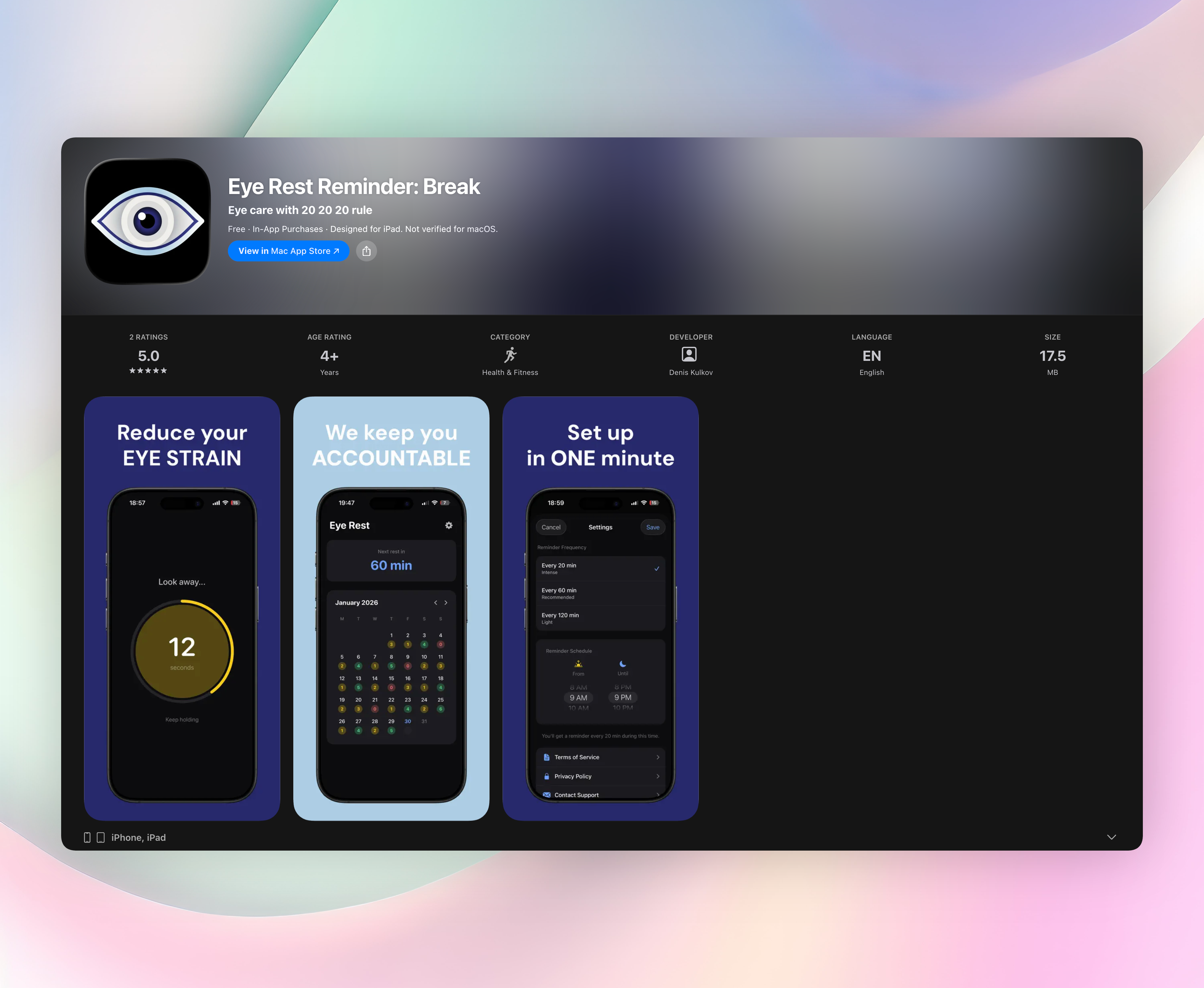
The usual cadence is the 20-20-20 rule, though its numbers are a convention rather than a validated dose — trials on break timing are small and inconsistent. Use it as a schedule you can keep, not a threshold with evidence behind it.
Why online vision tests measure almost nothing useful
A browser-based chart can't verify your viewing distance, your screen's physical size, its brightness, or how hard you're squinting. Most are acuity screeners attached to a storefront. They don't establish a cylinder axis reliably, don't assess how the two eyes work together, can't detect farsightedness masked by accommodation, and don't examine the eye itself — pressure, retina, lens, optic nerve. Passing one tells you that on a single day, at an unverified distance, you could read some letters.
When the strain isn't a prescription at all
- Dry eye. Blur that clears when you blink and returns seconds later, with burning or grittiness. Blink rate drops during concentrated screen work, though how much varies between studies.
- Binocular problems. Words that swim or double late in the day, or a reflex to close one eye, can come from difficulty sustaining convergence at near rather than from focus.
- Glare and contrast. A bright window behind the monitor produces symptoms no prescription fixes.
- Blue light. Systematic reviews of blue-light-filtering lenses haven't found a reliable benefit for eye strain, so treat it as unsettled rather than solved.
These coexist with refractive error more often than they replace it, which is another reason a home verdict tends to be wrong.
When to stop testing yourself
Some findings don't belong under "do I need glasses" at all. A sudden change in vision, new floaters or flashes, a shadow across part of your field, eye pain with nausea or halos, or new double vision mean prompt care, not monitoring.
FAQ
Do I need glasses or is it just screen fatigue?
Time it. Strain that arrives 20–30 minutes into every session and returns the moment you resume, including on a weekend with a book, behaves like uncorrected refractive error. Strain that builds over hours and clears after a real break behaves like fatigue.
Can astigmatism cause eye strain without blurry vision?
Yes, and that's the common presentation for small amounts. Acuity stays close to normal because the focusing system compensates continuously, so what you notice is brow ache, ghosted text, and night glare rather than obvious blur.
Are online vision tests accurate enough to skip an eye exam?
No. They can't control distance, screen calibration, or lighting, don't reliably measure astigmatism, and don't examine eye health. Treat one as a prompt to book an exam, not a substitute for it.
Why do I only get headaches on workdays?
Sustained near work is the load that exposes a small uncorrected prescription, and workdays apply it for eight hours. Weekends remove the load, the symptom disappears, and the cause stays hidden.
Does eye strain damage your eyes?
Current evidence doesn't show that screen-related eye strain causes lasting damage to the eye itself. That's separate from whether something correctable is producing the discomfort, which is what an exam settles.
Free Eye Rest Reminder tools
- 20 Minute TimerUse this 20 minute timer to mark the interval between eye breaks. Start a countdown, pause it when needed and reset it for the next interval.
- 20 Second TimerA 20 second timer for the 20-20-20 rule — every 20 minutes, look at something about 20 feet away for 20 seconds. Press start, or hit the space bar. One-tap 20, 30 and 60 second presets, a custom duration, an optional chime and a breathing circle to rest your eyes on.
- Break Interval TimerSet timer for 20 minutes, add a short break, and repeat the cycle for focused screen time. Every interval and cycle count is editable.
- Screen Break PlannerPlan screen breaks around your workday, lunch and meetings. Get a printable schedule with break times, break count, total break minutes and screen time after breaks.