Glare on computer screen: the two types and how to fix each
Glare on computer screen has two sources: light hitting your eyes directly from a window or ceiling fixture, and light bouncing off the panel into your eyes. Direct glare is fixed by moving the light or the desk; reflected glare is fixed by changing an angle. Filters and films come last, not first.
The two kinds of glare on computer screen
Direct glare is a light source bright enough to sit in your visual field beside the screen — a window behind the monitor, an unshaded lamp, a ceiling panel in front of you. Your pupil sizes itself to the brightest thing in view, so the screen looks washed out. The giveaway: shade your eyes with a hand and everything improves.
Reflected glare is the screen acting as a mirror. On a glossy panel that's a sharp reflection — you can read the window frame, or see your own shirt. On a matte panel it's veiling glare instead: a diffuse haze that lifts the blacks and flattens contrast until text loses its edges.
| Direct glare | Reflected glare | |
|---|---|---|
| Source | Bright light inside your field of view | Light bouncing off the panel toward you |
| Telltale | Washed-out screen; shading your eyes helps | You can see a window, lamp, or yourself in it |
| Cheapest fix | Move the desk, shade or block the source | Change the angle between source, screen, eyes |
| Does film help? | No | Yes — it diffuses the reflection |
The two usually occur together, which is why single fixes disappoint.
The ten-second test for screen glare
Turn the monitor off. A dark panel is a decent mirror, and whatever you see in it has been reflecting into your eyes all day. Do it at the hour you actually work — a west-facing room is a different room at 4 p.m.
For direct glare, hold a sheet of paper along the top edge of the monitor like a visor. If the screen instantly looks deeper and more legible, the problem is above you, not on the glass.
How to reduce screen glare, cheapest fix first
1. Move the desk
Put the window perpendicular to the screen — off to one side, not in front of you and not behind you. Facing a window gives you direct glare over the top of the monitor; backing onto one paints that whole rectangle into the panel. Rotating a desk costs nothing and beats anything you could buy.
2. Fix the lighting before the screen
Office lighting eye strain is rarely about too little light. It's uncontrolled light: fixtures directly above or in front of the screen, and a bright panel floating against a dim wall. Common ergonomic guidance puts desk lighting in the 300–500 lux range, screen-dominated work at the lower end, and keeps the screen within roughly 3:1 of its immediate surroundings.
So: kill the fixture directly overhead, put some light on the wall behind the monitor, and add a task lamp whose shade hides the bulb from your line of sight.
3. Tilt the screen, then set its height
Reflection follows mirror geometry — angle in equals angle out. Tilt the panel a few degrees with a black screen showing, and watch the reflected ceiling light slide off it.
Height is a separate lever. With the top of the screen at or just below eye level your gaze angles down, your lids sit lower, and less eye surface is exposed to the air — monitor position ergonomics doing double duty.
4. Match brightness to the room
A well-set screen looks about as bright as a sheet of white paper held beside it. Cranking it up to beat daylight works, but nobody remembers to turn it back down at night.
5. Film, filter, or hood — last
Matte anti-glare film diffuses sharp reflections into a soft haze — a real improvement on a glossy laptop, at the cost of slightly less crisp text. A monitor hood — a three-sided visor — is unglamorous and very effective against overhead direct glare. A privacy filter is a different product that darkens the image off-axis, so buy it for privacy, not as a glare filter monitor upgrade.
Why glare turns into eye strain
Glare doesn't damage anything; it changes how you use your eyes. You squint to cut incoming light and sharpen a low-contrast image, and squinting makes blinks partial rather than complete. Incomplete blinks don't resurface the whole tear film, so the eye dries between them — burning, grittiness, or blur that clears the moment you blink hard. Studies of screen use consistently find blink rate falls and incomplete blinks rise; the direction is well established, the exact numbers much less so. Add the brow tension of squinting and screen glare eye strain often arrives as a headache.
If the glare is gone and your eyes still ache
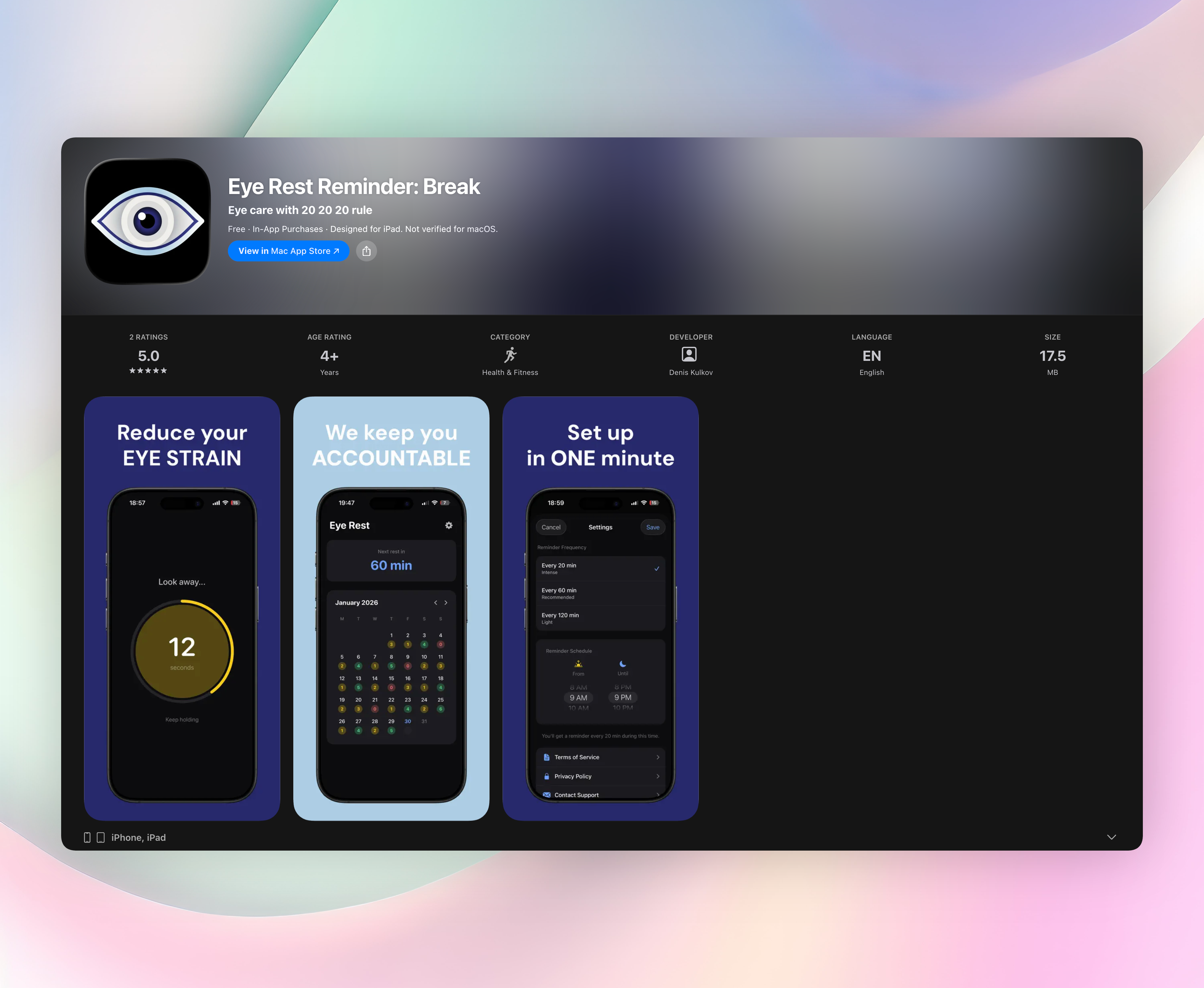
Re-run the black-screen test and confirm the reflections really are gone. If they are and symptoms continue, the remaining driver is almost always uninterrupted near-focus time — focusing and eye alignment held at one close distance for an hour straight, with no far target to relax to. That's what the 20-20-20 rule targets, and it fails for a boring reason: nobody remembers it while concentrating. Eye Rest Reminder is an eye-break reminder app for iPhone and Apple Watch, which mostly means the timing stops depending on you noticing.
FAQ
Does an anti glare screen protector help eye strain?
It cuts reflected glare, which is often what drives the squinting, but it does nothing about a bright window in your peripheral vision, and no film treats eye strain itself. Work the free angle and position fixes first.
Is blue light causing my eye strain?
The evidence is genuinely mixed, and better-controlled studies have not found blue light from screens to be the driver of eye-strain symptoms. Glare, brightness, dryness, and hours of uninterrupted near work all have stronger support behind them.
Does dark mode reduce glare?
Not the way people expect. In a bright room a dark background makes reflections more visible, because the panel is dimmer than whatever is reflecting off it. Dark mode helps most in a dim room, where a white page is the brightest object present.
Free Eye Rest Reminder tools
- 20 Minute TimerUse this 20 minute timer to mark the interval between eye breaks. Start a countdown, pause it when needed and reset it for the next interval.
- 20 Second TimerA 20 second timer for the 20-20-20 rule — every 20 minutes, look at something about 20 feet away for 20 seconds. Press start, or hit the space bar. One-tap 20, 30 and 60 second presets, a custom duration, an optional chime and a breathing circle to rest your eyes on.
- Break Interval TimerSet timer for 20 minutes, add a short break, and repeat the cycle for focused screen time. Every interval and cycle count is editable.
- Screen Break PlannerPlan screen breaks around your workday, lunch and meetings. Get a printable schedule with break times, break count, total break minutes and screen time after breaks.