Is blue light bad for your eyes, or just bad for your sleep?
Is blue light bad for your eyes? No good evidence says so — a cloudy sky delivers far more blue light to your retina than a phone does. Evening light and sleep is a separate question, and there the effect is real.
Where blue light actually comes from
Blue light is the short-wavelength end of the visible spectrum, roughly 400–500 nm. White LEDs — the backlight in nearly every modern display — emit it with a peak around 450 nm, which is why screens get singled out.
The comparison that gets skipped is daylight. Direct sun runs on the order of 100,000 lux at ground level; an overcast sky is still in the thousands. A well-lit office sits near 300–500 lux, and a phone at reading distance delivers tens of lux at your cornea. The sun dominates blue light exposure over a lifetime by a wide margin; screens aren't close. Dose determines whether light can damage tissue, and the screen's dose is small.
Is blue light bad for your eyes? What the damage research shows
The retinal-damage claim traces back to laboratory work: isolated retinal cells and animal retinas exposed to intense, narrow-band blue light show photochemical damage. Those exposures sit far above anything a display produces, delivered continuously and straight at the tissue.
Nobody has shown the same effect from consumer screens. There's no population evidence linking screen use to macular degeneration, and the American Academy of Ophthalmology doesn't recommend blue-light-blocking glasses for screen users — its position is that digital eye strain comes from how screens are used, not the color of the light.
Does blue light damage your eyes at screen brightness? Not that anyone has demonstrated. If you want to take chronic blue-light exposure seriously, take the sun seriously and wear sunglasses that block UV and short-wavelength visible light outdoors.
Why screens tire your eyes anyway
The discomfort is real; the wavelength explanation for it is wrong. What's happening is mechanical:
- Sustained accommodation. Your ciliary muscle holds focus at one near distance for hours and aches for the same reason any held contraction aches.
- Reduced and incomplete blinking. Blink rate drops during screen work, and more of the remaining blinks don't fully close the lid. The tear film thins; the eye feels gritty.
- Vergence demand. Both eyes converge on the same point and stay there without relief.
- Glare, low contrast, small text. Each raises the effort of every fixation.
None of that is a wavelength problem, and none of it responds to changing the color of the light. It responds to interruption — looking far away, blinking fully, letting focus reset. That's the logic behind the 20-20-20 rule, and why eye strain symptoms track hours-without-a-break more than screen type.
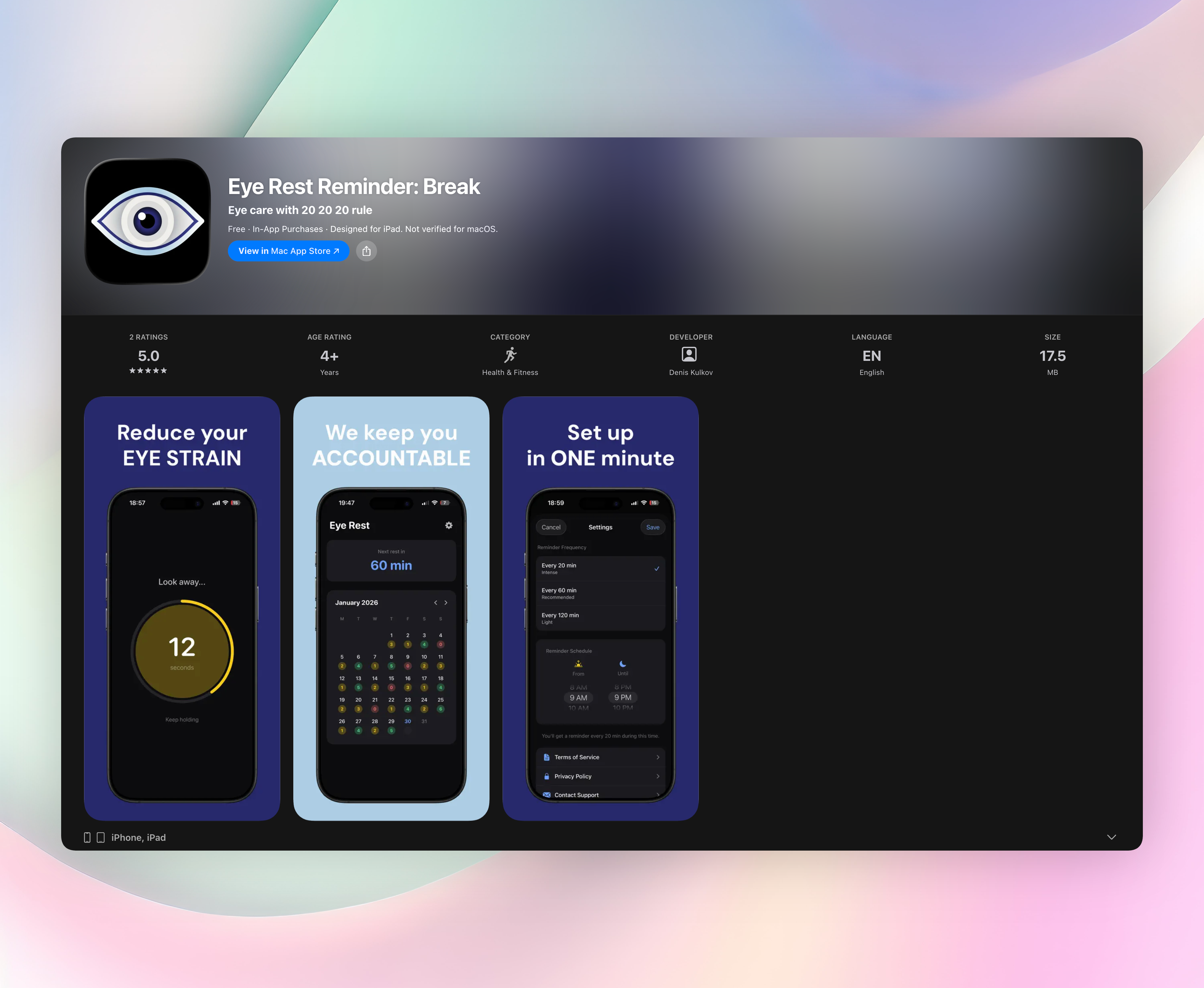
Breaks fail for a dull reason: absorbed in work, you don't notice the hours going by. An external prompt handles that better than intention does — Eye Rest Reminder is an eye-break reminder app for iPhone and Apple Watch, which puts the cue outside your own attention.
Blue light and sleep: the part with real evidence
Intrinsically photosensitive retinal ganglion cells, carrying the pigment melanopsin, report light levels to the brain's circadian clock. They peak in sensitivity around 480 nm, in the blue-cyan range. Light reaching them in the evening suppresses melatonin and pushes your internal clock later.
Three variables matter more than most coverage admits:
- Intensity. Total light at the eye drives the response. A dim screen in a dim room is a small stimulus; the same screen under bright overheads is not.
- Timing. The same light is trivial at noon and meaningful at 11 pm.
- The person. Sensitivity varies enormously — an evening exposure that flattens melatonin in one person barely registers in another.
Then there's the confound nobody removes cleanly: screen time before bed also involves content. Messages, video, and games keep you awake independent of any photon. A study that swaps the light's color but leaves the behavior in place is measuring one part of the problem.
What night mode and blue-light filters actually change
Night Shift, Night Light, and third-party blue light screen filters shift the display's white point toward amber, cutting a share of short-wavelength output. What none of them do on their own is reduce total brightness — a warm screen at full brightness still puts plenty of light in your eyes.
| Evening change | What it actually does | How strong the sleep evidence is |
|---|---|---|
| Night Shift / night mode | Warms the white point; brightness unchanged unless you also lower it | Trials comparing it on vs. off generally find small or inconsistent differences |
| Lowering screen brightness | Cuts light at every wavelength, including the 480 nm band | Consistent with the mechanism — total light drives the response |
| Blue-light-filtering glasses | Block some blue from every source, screens and lamps alike | Reviews find no meaningful benefit for eye strain; sleep evidence is thin |
| Dimming room lights | Overheads are often brighter at the eye than the screen is | Addresses the larger exposure in most rooms |
| Finishing screens earlier | Removes the light and the arousal together | Unconfounded, and the hardest to keep |
"Filters do nothing" is an overstatement in the other direction — they change the spectrum measurably. The gap is between the physics and the outcome: a real spectral change hasn't produced a large, reliable sleep improvement in the trials that have looked, which is roughly where blue-light glasses have landed too.
A practical evening setup
- Get bright light early. Morning outdoor light anchors the clock harder than any evening adjustment.
- Dim the room, not just the screen — overheads off, low warm lamps on, for the last hour or two.
- Lower screen brightness until the display roughly matches the room; auto-brightness undershoots this in the dark.
- Leave night mode on if you like it, but don't treat it as the whole intervention.
- Keep the last half hour low-arousal, and hold your wake time steady. Regularity moves circadian timing more than any single evening does.
Unproven is not disproven
"No evidence of harm at screen brightness" is a narrower claim than "blue light is safe." Some national health agencies have flagged intense LED sources — bright headlights, unshielded high-brightness emitters — with particular caution for children, whose lenses transmit more short-wavelength light. That's a different exposure from a display at ordinary brightness. Long-term data on decades of LED screen use doesn't exist yet, because LED screens haven't been around for decades. The state of play is "no signal," not "case closed."
FAQ
Does blue light damage your eyes?
Not at the levels screens produce, on the evidence available. Damaging retinal cells in the lab takes intensities far above what a display emits. The chronic exposure worth protecting against is sunlight — sunglasses outdoors matter more than filters indoors.
Is screen time before bed really that bad for sleep?
Evening light can delay your circadian clock and suppress melatonin, and screens contribute. But total brightness, how late it is, and how stimulating the content is all matter — and the content effect is often larger.
Does night mode actually help you sleep?
It changes the display's spectrum, but studies comparing night mode on versus off generally find small or inconsistent effects on sleep. Lowering brightness and dimming the room does more of what the color shift is supposed to do.
Which blue light effects on eyes are actually documented?
Two: the circadian pathway, where blue-cyan light near 480 nm shifts the body clock and suppresses melatonin, and discomfort from bright light generally. Retinal damage at screen-level exposure isn't on the list.
Free Eye Rest Reminder tools
- 20 Minute TimerUse this 20 minute timer to mark the interval between eye breaks. Start a countdown, pause it when needed and reset it for the next interval.
- 20 Second TimerA 20 second timer for the 20-20-20 rule — every 20 minutes, look at something about 20 feet away for 20 seconds. Press start, or hit the space bar. One-tap 20, 30 and 60 second presets, a custom duration, an optional chime and a breathing circle to rest your eyes on.
- Break Interval TimerSet timer for 20 minutes, add a short break, and repeat the cycle for focused screen time. Every interval and cycle count is editable.
- Screen Break PlannerPlan screen breaks around your workday, lunch and meetings. Get a printable schedule with break times, break count, total break minutes and screen time after breaks.