
Eye exercises for eye strain: six to do, and what they can't fix
Eye exercises for eye strain target the muscles screen work actually fatigues: the focusing muscle inside the eye, the muscles that aim both eyes at close text, and the lids. They relieve discomfort and take seconds. They do not change your prescription.
What eye exercises for eye strain actually target
The ciliary muscle inside the eye contracts to bulge the lens for near focus. Hold a monitor at 24 inches for two hours; that muscle stays contracted the whole time. The ache is sustained tension, not weakness, so the exercises that help relax the muscle rather than train it.
The extraocular muscles, mainly the medial recti, rotate both eyes inward to converge on near text, held that way the whole time you read. Some people have a true convergence insufficiency, where sustaining it is harder than it should be; words swim or double after twenty minutes.
The orbicularis oculi closes the lid. Resting blink rate runs 15–20 a minute and drops during screen work, often by half or more, with more of the remaining blinks incomplete. So the gritty, burning half of screen fatigue is usually a thin tear film, not muscle, and how often you blink matters as much as how often you look away.
Six eye strain exercises, with duration and frequency
| Exercise | Duration | Frequency | What it targets |
|---|---|---|---|
| Distance refocusing | 20 seconds | Every 20 minutes | Ciliary relaxation |
| Near–far pencil push-ups | 60–90 seconds | Once or twice daily | Convergence control |
| Palming | 30–60 seconds | 2–3 times daily | Dark rest |
| Figure-eight tracking | 20–30 seconds | Once or twice daily | Smooth pursuit |
| Deliberate full blinks | 10 seconds | Every 20 minutes | Tear film spread |
| Warm lid massage | 5 minutes | Once daily | Meibomian glands |
Distance refocusing
Every 20 minutes, look at something at least 20 feet away and hold it for 20 seconds — the 20-20-20 rule. At that distance accommodation is effectively at rest, so the ciliary muscle stops working. The numbers are a convention, not a validated dose; what matters is releasing the muscle before an hour passes.
Near–far pencil push-ups
Hold a pencil at arm's length with a small letter on it. Bring it slowly toward the bridge of your nose, stop the moment it doubles or blurs, then push it back out. Ten to fifteen reps. Push-ups are a standard home add-on for diagnosed convergence insufficiency; in-office vergence therapy tends to outperform them.
Palming
Warm your palms and cup them over closed eyes, heels resting on your cheekbones, without pressing on the eyeball. Sit in the dark 30–60 seconds. What the palming eye exercise delivers is rest with the visual load removed; claims that it sharpens vision trace back to the Bates method and haven't held up.
Figure-eight tracking
Picture a large figure eight lying on its side about 10 feet ahead and trace it slowly with your eyes, head still, reversing halfway. This drives smooth pursuit rather than focus, and direct evidence is thin — its value is that a break with a task attached actually gets taken.
Deliberate full blinks
Close the lids fully, pause a beat, squeeze gently, open. Five in a row. The word doing the work is full — partial blinks leave the lower lid margin dry and don't spread the oil layer. Do these mid-task, while your blink rate is suppressed.
Warm lid massage
Apply a comfortably warm compress for about five minutes, then stroke the lids toward the lash line with a clean fingertip. This softens and expresses the oil the meibomian glands produce, and of the six it has the most consistent evidence behind it for easing dryness.
What eye exercises cannot do
They will not reverse myopia or reduce a prescription, whatever a program marketed as eye yoga exercises claims. Nearsightedness is largely a matter of the eyeball being too long front to back, and no muscle drill shortens an eyeball. Research on eye fatigue exercises measures subjective comfort, a different outcome from measured acuity.
Eye strain is uncomfortable but isn't known to cause lasting damage. The evidence that blue light drives strain is mixed at best — blue-filtering lenses haven't shown reliable benefit, while dryness and break timing have better track records.
A routine that fits inside a normal break
Most eye-exercise routines fail because they're scheduled as a separate 15-minute session. Nobody does that twice. Size every piece to a break you already take:
- Every 20 minutes: a 20-second distance refocus, then five full blinks — about half a minute.
- Mid-morning and mid-afternoon: pencil push-ups or a figure eight, roughly a minute.
- Evening: warm compress and lid massage while you're doing something else anyway.
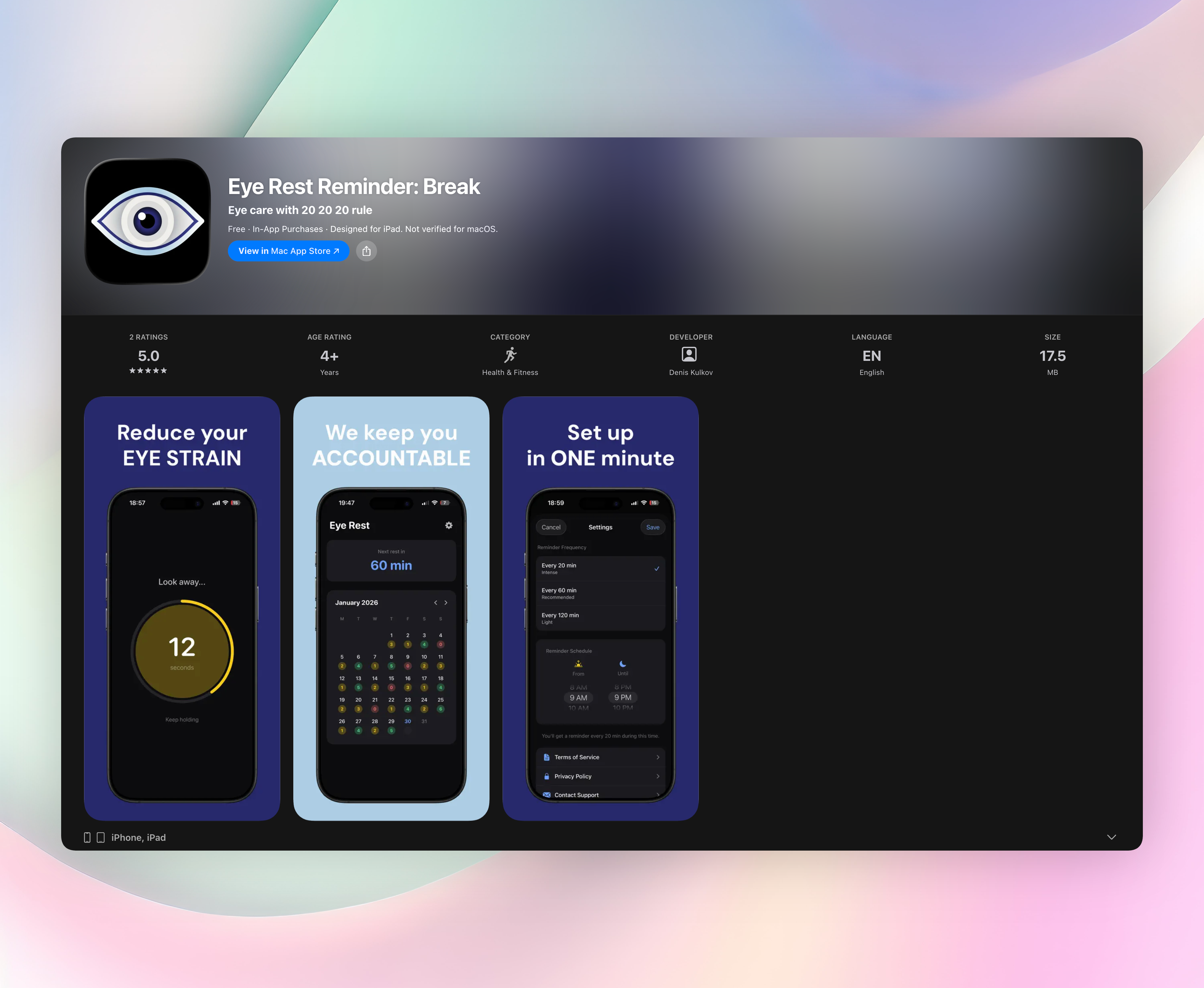
Everything in that first tier fits inside 30 seconds — it rides along with a break you're already taking instead of demanding its own slot. Eye Rest Reminder, an eye-break reminder app for iPhone and Apple Watch, is one way to hold that 20-minute cadence without watching a clock.
When the problem isn't strain
If symptoms persist through a few weeks of consistent breaks, the cause is usually something no exercise reaches: uncorrected astigmatism, early presbyopia, a convergence disorder, or dry eye disease. Start by naming which symptoms you actually have. Eye pain, sudden vision change, persistent double vision, halos, or a shower of new floaters are not strain — call an eye doctor the same day.
FAQ
How long do eye exercises take to help eye strain?
Distance refocusing and full blinks work within the session — less ache and less grit the same afternoon. Lid massage for dryness needs a few weeks of consistent use. If nothing has shifted after a month, book an exam rather than adding exercises.
Do eye exercises for computer users improve eyesight?
No. They reduce the discomfort of sustained near work but don't change refractive error, so your prescription stays where it is. Anything promising sharper uncorrected vision from a drill is overselling.
Is the palming eye exercise safe?
For most people, yes, provided the heels of your hands rest on your cheekbones and you never press on the eyes themselves. Pressure on the globe is the thing to avoid — check with your doctor first if you have glaucoma or recent eye surgery.
How many times a day should I do eye strain exercises?
The short ones scale with screen time: a 20-second refocus and five full blinks every 20 minutes. The longer drills need once or twice a day. Frequency beats duration: small releases keep the focusing muscle from settling into one long contraction.
Free Eye Rest Reminder tools
- 20 Minute TimerUse this 20 minute timer to mark the interval between eye breaks. Start a countdown, pause it when needed and reset it for the next interval.
- 20 Second TimerA 20 second timer for the 20-20-20 rule — every 20 minutes, look at something about 20 feet away for 20 seconds. Press start, or hit the space bar. One-tap 20, 30 and 60 second presets, a custom duration, an optional chime and a breathing circle to rest your eyes on.
- Break Interval TimerSet timer for 20 minutes, add a short break, and repeat the cycle for focused screen time. Every interval and cycle count is editable.
- Screen Break PlannerPlan screen breaks around your workday, lunch and meetings. Get a printable schedule with break times, break count, total break minutes and screen time after breaks.